Astoria trash club
June 2026
Live Website
Designing and Engineering a Community Platform with AI-Assisted Development
This case study showcases my end-to-end product development process as a design engineer. Beyond designing the MVP, I built the product using Cursor AI, integrated an Airtable database, developed automation triggers to streamline workflows, and deployed the final application to Vercel. This project highlights my ability to bridge product design and engineering by taking an idea from concept to a fully functional, production-ready experience.
What is Astoria Trash Club?
Astoria Trash Club is a volunteer-led community organization focused on neighborhood cleanups, environmental stewardship, and civic engagement in Astoria, Queens.

Designed and launched Astoria Trash Club’s first centralized digital platform, streamlining volunteer engagement, event discovery, and community participation while creating scalable infrastructure for the organization’s growth.
Role
Product Design
Frontend Development
Information Architecture
Content Strategy
Technical Architecture
Team
Lead volunteers - content
1x Product Designer
2x Engineers (self included)
Impact
Streamlined volunteer event discovery
Launched a production-ready website in weeks
Led end-to-end product development
Built scalable infrastructure
Tools used:

"What began as a neighborhood cleanup movement needed a digital home that could turn community interest into real-world action."
- Samantha Richards, Strategic Product Designer
Problem area
Growing beyond social media
Prior to the website, most community engagement occurred through Instagram. While social media was effective for promotion, it created several challenges: Information Fragmentation, Event Management Overhead and Accessibillity Concerns.

Problem Statement
Astoria Trash Club relied on Instagram for coordination, creating fragmented information and excluding non–social media users from easily accessing event updates, participation details, and key community information.
Initial website launch goals
As both the primary product designer and builder of the website, my goal was to create a centralized platform that would:

Streamline Volunteer Operations
Reduce repetitive administrative work by creating a scalable system for managing events, registrations, and community updates in one place. Creating a trigger for our Google Calendar syncing.

Accelerate Development with AI

Create a Single Source of Truth
Move essential information out of scattered Instagram posts and into a dedicated website where visitors can easily learn about the organization, volunteer, and find answers.

Build for Community Collaboration
Established a GitHub collaborative workflow with shared ownership, enabling future contributors to maintain code quality, UI consistency and reliable integrations as the project grows.
The project combined product design, frontend development, database architecture, content strategy, and AI-assisted engineering workflows.
Discovery & Stakeholder Collaboration
Defining the problem before designing the solution
Before designing the website, I collaborated with lead volunteers to define project goals, user needs, and content priorities, using Google Docs as a single source of truth for asynchronous collaboration and feedback.
Collaborative Content Workflow

Streamline Volunteer Operations
Empowering non-technical contributors with Airtable
Instead of hardcoding events, I created a structured Airtable database that served as the source of truth. The database stores: event title, date, time, location, description and event photo.
This allowed volunteers to update event information through Airtable without touching code.
Airtable powered the website's event content while also integrating with Google Calendar, allowing volunteers to easily add upcoming cleanups to their personal calendars and stay informed.

Automating event management
Keeping Airtable and Google Calendar in sync.
To reduce repetitive administrative work, I built an automation in Airtable that automatically creates a Google Calendar event whenever a new cleanup is added. The trigger monitors for records that meet specific conditions (such as missing a Google Calendar Event ID) and initiates the workflow without requiring any manual intervention from volunteers.
Once the event is created, the automation writes the newly generated Google Calendar Event ID back into Airtable, creating a reliable two-way connection between the CMS and calendar. This ensures every cleanup is published consistently, prevents duplicate events, and allows non-technical organizers to manage community events from a single Airtable interface while automating the synchronization behind the scenes.
Trigger automation - push events to Google Calendar

Events successfully generated

Benefits
Reduced maintenance overhead
Non-technical contributor friendly
Faster content updates
Single source of truth
AI-Assisted Development with Cursor
Accelerating development with AI-assisted workflows
One of the most impactful parts of this project was building with Cursor as an AI-native development environment. Rather than using AI to simply generate code, I treated it as a collaborative engineering partner, brainstorming implementation approaches, scaffolding components, and accelerating feature development while keeping architectural decisions and product direction under my control.
Coding in Cursor
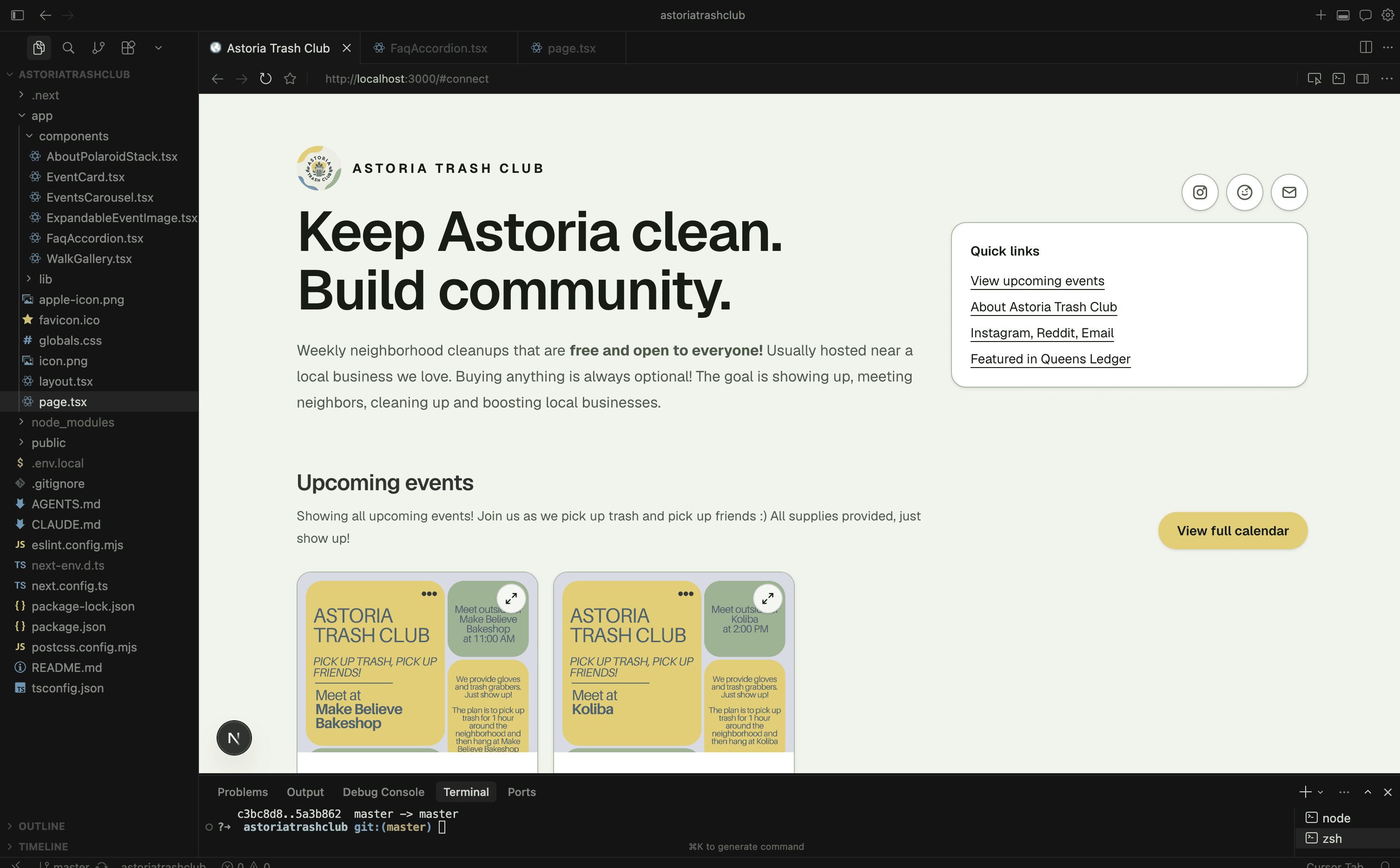
Initial Cursor AI prompt:
Build a modern, responsive public website for Astoria Trash Club that introduces the club's brand ("Keep Astoria clean. Build community."), explains its free, beginner-friendly neighborhood cleanups, highlights local business partnerships, features an events/calendar section, includes links to Instagram, WhatsApp, and donations, and uses well-structured placeholder content and assets that can easily be replaced with real copy, images, and links later.
Refining code through AI collaboration
Beyond writing code, Cursor became an integral part of the development workflow by helping identify bugs, explain unfamiliar patterns, suggest refactors, and support rapid iteration throughout the project. Together, we evolved the site from initial event cards and calendar improvements to live Airtable integration, polished UI and copy, enhanced About, Gallery, and FAQ sections, stakeholder-driven refinements, and production-ready navigation, allowing me to ship features faster while maintaining code quality, UI consistency, and a clean, scalable codebase.

Key impact
This approach significantly accelerated development while maintaining engineering standards.
Single Source of Truth
From social feed to community hub
Before the website, important information was scattered across Instagram posts, stories, captions, and direct messages, making it difficult for both new and returning volunteers to find what they needed. This fragmented experience also excluded community members who didn't actively use social media, limiting access to events and organization updates.
To solve this, I designed a centralized website that became Astoria Trash Club's digital home. By consolidating content into a dedicated platform, the organization created a more accessible, consistent, and scalable experience for its growing community.

GitHub Collaboration Workflow
Shipping together through shared ownership
To support long-term community ownership, the project was built around a shared GitHub repository that allows future contributors to maintain, improve, and expand the platform beyond the original team. Using collaborative development practices (including feature branches, focused pull requests, and code reviews) we maintained code quality, UI consistency, and stable integrations while enabling parallel development.
For example, a dedicated "wip-map" branch was created for the upcoming redesign, allowing exploration of new experiences and features without disrupting the live production branch. This workflow established a scalable foundation for the Astoria Trash Club website to evolve as a community-driven project where members can continue shipping improvements together.
Github workflow
This workflow mirrored professional software development practices despite being a volunteer-led community project.

Deployment
From commit to production in minutes
The deployment workflow streamlined the path from development to a live product through GitHub and Vercel integration. Every approved code change pushed to the repository could automatically trigger a new deployment, allowing updates to move from commit to production quickly and reliably. This automated pipeline reduced manual steps, improved iteration speed, and ensured the website remained stable as new features and improvements were shipped.

Benefits
Continuous deployment
Preview environments
Fast rollback capability
Reduced operational overhead
Each merged change automatically triggered a new deployment, allowing the team to iterate rapidly.
Check out the live website 🎉
Retrospective & Impact
Creating lasting community impact
Launching the Astoria Trash Club MVP proved that shipping early creates momentum. Using Figma, Cursor AI, Airtable, and Vercel, I transformed a community that relied on Instagram and messaging into one with a centralized home for events, resources, and volunteer engagement. In less than a year, the club has built an active and growing community, streamlined event coordination, strengthened partnerships with local businesses, and created a scalable digital foundation that will continue to support its growth.

"The website made me feel like I wasn't missing out just because I don't use Instagram."

Chris
Group Member
Next Steps: Redesign & Rebranding
The future of Astoria Trash Club
The MVP successfully validated the concept, but the next phase is about creating a brand that feels uniquely Astoria. I'm leading a full redesign and rebrand that moves away from generic AI-generated aesthetics toward a personality-driven experience with custom illustrations, richer storytelling, and a stronger community identity. We're inviting members to co-create an Astoria Trash Club Illustration System in Figma, which will power the website, social content, and new merchandise launching for the club's one-year anniversary on September 21, 2026.
Building the Foundation for a New Identity
Early concepts and design explorations shaping a more authentic, community-driven identity.

Sneak peak:
A living map of community impact
The upcoming map feature creates a visual archive of cleanups, partnerships, and gatherings, turning the website into a destination that celebrates everything the community has built together.

Key impact
Replace generic AI branding with an authentic, community-crafted identity that people can rally behind. Building a cohesive brand system that scales across the website, social media, and merchandise.

